
 By IKadverts
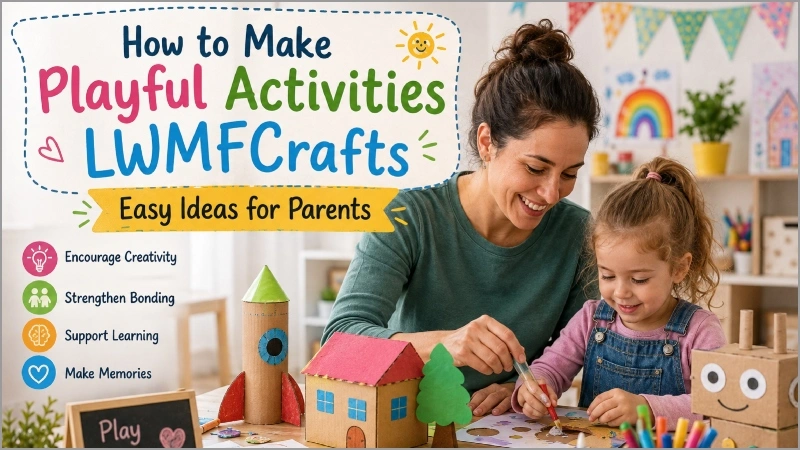
Parenting does not have to mean filling every afternoon with expensive toys, worksheets, or complicated projects. Sometimes, the best learning happens when children simply get a chance to create, explore, imagine, and play.
If you are wondering How to Make Playful Activities LWMFCrafts, the answer starts with a simple idea: use everyday materials to turn ordinary moments into opportunities for creativity and connection. Play can support children’s cognitive, social, emotional, language, and physical development while also strengthening the parent-child relationship.
What Makes an Activity Truly Playful?
A playful activity should give children room to make choices. Instead of telling them exactly what the finished project should look like, give them a few materials and let their imagination take the lead.
For example, provide paper, cardboard, crayons, glue, and safe recycled materials. Ask your child what they could create with them. One child might build a pretend house, while another creates a robot or animal.
This approach combines structured guidance with child-led play. The American Academy of Pediatrics notes that guided and free play can support skills such as problem-solving, self-regulation, language, creativity, and social development.
How to Make Playful Activities LWMFCrafts at Home
You can enjoy creative activities with whatever space you have at home. A small table, a washable surface, and a box of basic supplies can be enough.
1. Create a Story From Paper
Give your child several sheets of paper and invite them to draw three things: a character, a place, and an object.
Then work together to create a short story using all three.
For younger kids, try encouraging them with easy, open-ended questions:
- What is your character’s name?
- Where are they going?
- What happens next?
- How can we help them?
This turns a basic drawing activity into storytelling and conversation practice.
2. Build With Recycled Materials
Save clean cardboard boxes, paper tubes, paper scraps, and containers that are safe for children’s use.
Challenge your child to build something useful or imaginary. It could be a cardboard city, a toy garage, a spaceship, or a miniature animal home.
The important part is not the final product. Let your child experiment, change their design, and solve problems when something does not work.
3. Make a Color Hunt
Choose three or four colors and ask your child to find safe objects around the home that match them.
For example, they might find a blue book, a yellow toy, and a red cup.
For older children, turn it into a sorting game. Ask them to group objects by color, size, shape, or material. This adds early math and observation skills without making the activity feel like a lesson.
4. Turn Everyday Chores Into Play
Play does not always require craft supplies.
While cooking, ask your child to count ingredients. During laundry, let them sort socks by color. While walking outside, create a scavenger hunt for leaves, interesting shapes, or different sounds.
UNICEF recommends using everyday routines and simple activities as opportunities for children to play and learn together with their caregivers. Discover more creative ideas, helpful tips, and fun activities for kids and parents on our website.
How to Make Playful Activities LWMFCrafts More Engaging
The biggest mistake parents can make is focusing too much on getting the “right” result.
Instead, focus on the process.
If your child colors outside the lines, let it happen. If their paper airplane does not fly, ask what they could change. If their cardboard creation looks completely different from what you expected, celebrate the idea behind it.
Try asking questions instead of giving instructions:
“What do you think will happen?”
“What could we try next?”
“How would you make it stronger?”
These questions encourage children to think, test ideas, and explain their choices.
Easy Activities for Different Ages
The same basic activity can work for children at different developmental stages.
Toddlers: Focus on simple sensory play, scribbling, stacking, sorting, and supervised exploration.
Preschoolers: Try pretend play, simple crafts, storytelling, matching games, and building projects.
School-age children: Introduce challenges such as designing a paper bridge, creating a board game, making a comic strip, or building a model from recycled materials.
Always choose materials and activities that match your child’s age and abilities. Young children also need close supervision around small parts, scissors, glue, and other craft materials.
Why Play Matters in Parenting
Play is more than a way to keep children occupied. Research from the American Academy of Pediatrics connects developmentally appropriate play with social-emotional skills, executive function, language, problem-solving, and physical development.
It also gives parents a chance to understand how their children think.
When you sit beside your child while they build a tower or invent a story, you may discover their interests, worries, sense of humor, and unique way of solving problems. That shared attention can strengthen your relationship.
A Simple 15-Minute Play Routine
You do not need hours of free time. Try this simple routine:
5 minutes: Let your child choose the activity and materials.
5 minutes: Play alongside them without taking over.
5 minutes: Ask them to explain what they made or what they discovered.
This keeps the activity manageable for busy families while giving children meaningful time for creativity and connection.
Final Thoughts
Learning How to Make Playful Activities LWMFCrafts does not require complicated instructions or expensive supplies. The most successful activities are often simple, flexible, and easy to adapt.
Start with what you already have at home. Follow your child’s interests, leave room for mistakes, and focus on curiosity rather than perfection.
When parents make space for playful learning, children get something valuable: the freedom to create, solve problems, express themselves, and enjoy learning through real experiences. As UNICEF and the American Academy of Pediatrics emphasize, play can be a meaningful part of healthy development and strong family relationships.Find more inspiration for playful learning and easy family-friendly crafts on our website.