
 By IKadverts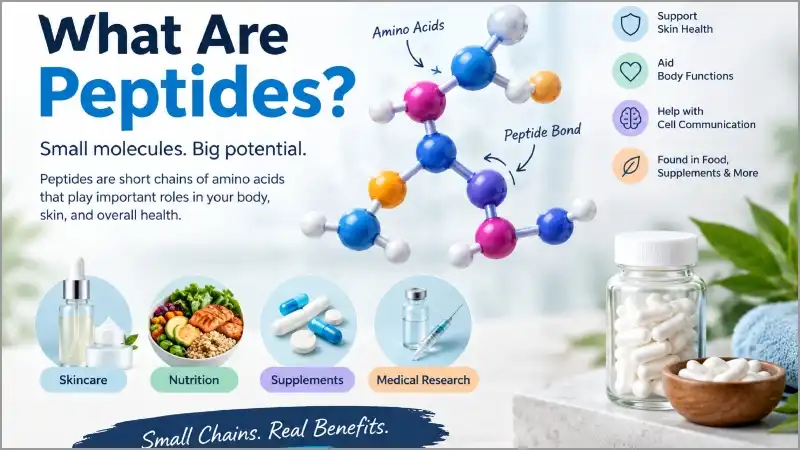
Peptides have become a popular topic in skincare, nutrition, fitness, and medical research. You may see them listed on cosmetic labels, discussed in scientific studies, or mentioned in conversations about modern treatments. But what are peptides, and why have they attracted so much attention?
At their simplest, peptides are molecules made from amino acids. Their small size allows them to take part in many biological processes, making them useful in both natural body functions and scientific research.
What Are Peptides Made Of?
To understand what are peptides, start with amino acids. Your body uses amino acids to build many important substances, including peptides and proteins.
When several amino acids connect through chemical bonds called peptide bonds, they create a peptide chain. The sequence and arrangement of those amino acids influence how the resulting peptide behaves.
Some peptides occur naturally in the human body, while scientists can create others in laboratories for specific research, cosmetic, nutritional, or medical purposes.
Peptides and Proteins Are Related
Peptides and proteins belong to the same broad biological family because both contain amino acids. The main difference involves their size, structure, and biological complexity.
Proteins generally contain longer amino acid chains and often fold into larger structures. Peptides are typically shorter chains, although scientists do not use one universal length to draw a strict line between a peptide and a protein.
This distinction helps explain why different peptides can have very different properties.
How Do Peptides Function?
One reason what are peptides receive so much interest is their ability to participate in biological communication.
Certain peptides can act as signaling molecules. They may interact with specific receptors or other molecules and influence processes within the body. Other peptides have structural, regulatory, or protective roles.
A useful way to think about them is as small molecular messengers. Their sequence and three-dimensional structure can determine what they interact with and what biological response may follow.
Peptides in Skincare
The beauty industry has embraced peptides because some peptide ingredients are designed to support skin appearance and condition.
You can find peptides in products such as moisturizers, facial serums, eye creams, and anti-aging formulations. Different ingredients are studied for different purposes, including supporting skin structure, hydration, and firmness.
However, it is important to look beyond the word “peptide” on a product label. What are peptides in one serum may be quite different from the peptide used in another formula.
Product formulation, ingredient stability, concentration, and consistent use can all affect the overall experience.
Peptides in Food and Nutrition
Peptides are also relevant to nutrition. During digestion, enzymes break dietary proteins into smaller fragments, including peptides and individual amino acids.
Researchers have also investigated naturally occurring food-derived peptides for their potential biological activities. This area has applications in nutrition science and the development of functional foods.
Still, promising laboratory research does not automatically mean that a particular peptide provides a proven health benefit when consumed. Researchers need appropriate human studies to determine how well a finding translates into real-world use.
Peptides in Medicine and Research
Modern science has developed peptide-based medicines for specific medical applications. Some interact with receptors involved in important physiological processes.
Scientists continue to explore peptide-based treatments because researchers can design certain peptides to interact with particular biological targets.
At the same time, peptide medicines can present technical challenges. Some peptides may break down quickly, have limited stability, or require specialized delivery methods. These factors make pharmaceutical development more complex than simply creating a peptide and giving it to a patient.
Are Peptides Always Safe?
The answer depends on the individual peptide and how someone uses it.
A peptide used as a cosmetic ingredient is not necessarily equivalent to a prescription peptide medicine or an experimental compound. Each has a different purpose, formulation, manufacturing process, and safety profile.
People should be particularly careful with injectable or experimental peptide products purchased from unreliable sources. Medical products should be discussed with an appropriately qualified healthcare professional rather than treated like ordinary supplements.
For everyday skincare, follow the product directions and pay attention to how your skin responds.
Why Are Peptides Getting So Much Attention?
The growing interest comes from their versatility. They can appear in several areas at once, from cosmetic science and nutrition to biotechnology and medicine.
Another reason is precision. Researchers can study individual peptide sequences and investigate how they interact with particular biological pathways. This makes peptides valuable tools for understanding complex biological systems.
However, popularity should not be confused with proof. When evaluating a peptide product or claim, consider the quality of the research rather than relying only on advertising language.
What Are Peptides? The Simple Answer
So, what are peptides? They are short chains of amino acids that can perform or influence different biological functions. Some occur naturally in the body, while others are produced through scientific and industrial processes.
Their uses range from skincare and food research to advanced medical applications. But peptides are not one universal ingredient with one universal effect. Each peptide needs to be evaluated according to its structure, purpose, evidence, and method of use.
The best approach is to treat peptide claims realistically. Learn which peptide is involved, understand what it is designed to do, and look for credible evidence before assuming that a product will deliver a particular result.
Final Thoughts
Understanding what are peptides gives you a useful foundation for making sense of the growing number of peptide-related products and discussions online. They are small but biologically interesting molecules with applications across several fields.
Whether you encounter peptides in a skincare bottle, a nutrition study, or medical research, the same principle applies: the specific peptide matters. Looking at the science behind the ingredient is far more useful than judging it by the label alone.